
Biography Of Kazi Nazrul Islam
The Rebel Poet of Bengal
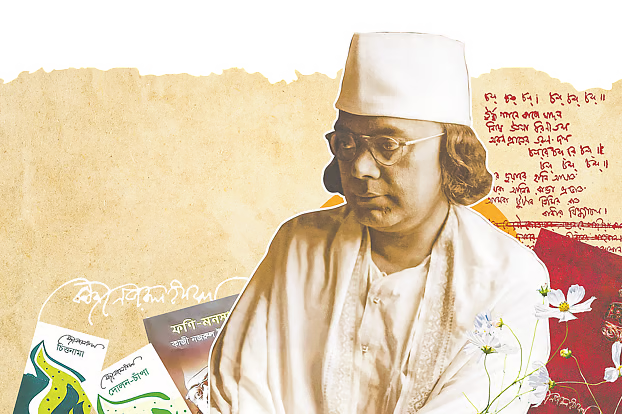
Early Life
Kazi Nazrul Islam was born on 24 May 1899 in the village of Churulia, in the Burdwan district of Bengal (then British India). He was the second of four children. His childhood nickname was “Dukhu Mia”, reflecting the hardship and struggles he faced from an early age.
In 1908, Nazrul lost his father at the age of nine. This sudden loss forced him into responsibilities far beyond his years and deeply shaped his outlook on life, suffering, and resilience.
Family and Education
After his father’s death, Nazrul worked as a muezzin at a local mosque and later as a school teacher. During this period, he gained a strong foundation in religious studies, which later influenced much of his poetry and music.
Poverty repeatedly interrupted his formal education. At times, he left school to work in tea stalls, bakeries, and with travelling theatre groups. Despite these challenges, his passion for learning and creativity never faded.
Literary Journey
Nazrul Islam emerged as a defining literary voice of post-Tagore modern Bengali literature. His poetry, essays, novels, and plays introduced bold themes and a powerful new language.
His writings spoke against:
Colonial oppression and imperialism
Social injustice and inequality
Religious intolerance and communal division
Nazrul’s work transformed Bengali poetry with new rhythms, fiery emotion, and a fearless spirit of rebellion.
Revolutionary Spirit
Nazrul was not only a poet but also a revolutionary thinker. His iconic poem “Bidrohi” (The Rebel), published in 1922, made him an instant symbol of resistance.
His fearless writings alarmed the British colonial authorities:
Several of his books were banned.
He was imprisoned multiple times.
Nazrul used literature as a weapon against injustice, firmly believing that art must stand with truth and freedom.
Prison Life
During imprisonment, Nazrul protested inhumane treatment by launching a 40-day hunger strike. His health deteriorated, yet his spirit remained unbroken.
At this time, Rabindranath Tagore sent him a telegram that read:
“Give up the hunger strike. Our literature claims you.”
Even in prison, Nazrul continued to write poems and songs, proving his extraordinary mental strength and dedication.
Musical Contribution
Nazrul Islam made an unparalleled contribution to Bengali music. He composed and wrote thousands of songs, now known as Nazrul Geeti.
Key features of his music:
Fusion of classical ragas with folk traditions
Equal mastery of Islamic devotional songs, Shyama Sangeet, bhajans, and kirtans
Introduction of the Bengali ghazal
His musical legacy broke rigid boundaries and brought spiritual harmony into Bengali culture.
Film, Radio, and Cultural Work
During the 1930s and 1940s, Nazrul actively worked in:
Film music composition
All India Radio
Gramophone recordings
Through radio and recordings, his music reached a wider audience and shaped modern Bengali musical identity.
Personal Tragedy and Illness
Nazrul’s personal life was marked by deep sorrow. He endured:
The death of his mother
The loss of his young son Bulbul
His wife Pramila Devi’s prolonged illness
In 1942, Nazrul fell seriously ill and gradually lost his power of speech. He spent the next 34 years in silence, a tragic contrast to his once fiery voice.
Awards and Recognition
Nazrul’s personal life was marked by deep sorrow. He endured:
The death of his mother
The loss of his young son Bulbul
His wife Pramila Devi’s prolonged illness
In 1942, Nazrul fell seriously ill and gradually lost his power of speech. He spent the next 34 years in silence, a tragic contrast to his once fiery voice.
Final Years and Death
In 1972, Nazrul was brought to Bangladesh, where he spent his final years under state care.
He passed away on 29 August 1976 in Dhaka. He was buried with full state honors near the Dhaka University Central Mosque.
Legacy
Today, Kazi Nazrul Islam stands as:
The National Poet of Bangladesh
A symbol of rebellion, equality, and human dignity
A timeless voice of justice and unity
His words continue to inspire generations to stand against oppression and to believe in the power of courage and compassion.
Timeline: Key Milestones of Kazi Nazrul Islam
1899 – Born on 24 May in Churulia, Burdwan, India.
1908 – Father, Kazi Fakir Ahmad, dies; Nazrul takes early responsibilities.
1910–1917 – Interrupted education; works as teacher, muezzin, bakery & tea shop assistant; joins folk-opera group; develops early literary skills.
1917 – Joins the 49th Bengal Regiment, serves in the Indian Army, and continues writing.
1919 – First publication: The Autobiography of a Vagabond in Saogat magazine.
1920 – Returns to Calcutta; begins journalistic & literary career.
1921 – Meets Rabindranath Tagore; engagement with Nargis; deep involvement in patriotic activities.
1922 – Publishes Bidrohi (The Rebel), Agnibeena; banned works lead to first imprisonment.
1923 – Imprisoned; begins 40-day hunger strike in protest of inhumane treatment.
1924 – Marries Pramila; publication of two poetry volumes banned by the British Government.
1925–1927 – Actively participates in political & cultural movements; publishes patriotic songs; begins music innovation in Krishnanagar.
1928–1932 – Works with gramophone companies & radio; popularizes Nazrul Geeti.
1933–1939 – Engaged in films, All India Radio programs; writes and directs songs and plays.
1941–1942 – Falls seriously ill; recites Quran; final active years of music and literature.
1942–1976 – Lives in silence due to illness; receives various awards, including Jagattarini Gold Medal, Padma Bhushan, and Ekushey Padak.
1972 – Moves to Bangladesh; welcomed as National Poet.
1976 – Passes away on 29 August in Dhaka; buried with state honors near Dhaka University Central Mosque.